Why Going to College Makes Sense for Today’s Youth – Grant Cooper, President Strategic Resumes of New Orleans

Peter Thiel
It was just reported that PayPal co-founder & venture capitalist Peter Thiel is offering $100,000 to 24 young entrepreneurs… PROVIDING that they stay out of college for two years to further their business ideas. Thiel, who apparently didn’t practice what he preaches, earned his undergraduate degree and law degree from Stanford University.

He has now appointed the 24 Thiel Fellows for the 20 Under 20 Thiel Fellowship to pursue “innovative scientific and technical projects, learn entrepreneurship, and begin to build the technology companies of tomorrow.” Over a 2-year period, each Fellow will receive $100,000 and mentorship from Thiel’s impressive network, as long as they agree to stay out of college. Upon announcing the fellowship program last year, Thiel stated that many of the world’s most transformative technologies have been created by people “who’ve dropped out of school because they had ideas that couldn’t wait until graduation.”

This announcement comes on the heels of extensive media coverage of rising college tuition costs and a barrage of articles on whether a university degree is still worth pursuing. Just this month (May 2011), the Pew Research Center reported that 57% of respondents believe that higher education is not worth the cost and 75% feel that college is now too expensive for the average American.

According to the College Board, tuition at private universities has tripled over the past 30 years, and costs at public universities go up nearly every year. The National Center for Public Policy and Higher Education reports that tuition has increased 5.6% per year above the rate of overall inflation.

Even with the growing skepticism and increased costs of higher education, college education remains a top priority in the. U.S. Fully 94% of parents Pew surveyed plan on sending their child to college.

The Pew report stated that those who graduated from a four-year college believed they earn $20,000 more per year on average due to possessing a degree. Those estimates closely adhere to recent U.S. Census findings that show the average gap in earnings between college and high school graduates is $19,550.

As a dad of 3 young adults (1 earns 6-figures, 1 is entering med school, 1 still an undergrad), as a “child of the ’60s” who got a GED and went on to be a successful entrepreneur with a college degree, and as a Career Coach/Resume Writer with 2 decades advising clients, I have a few insights hopefully worth sharing.

So, to the young people reading this who are wondering if they need a college degree… No. Bill Gates and Peter Thiel are both entrepreneurs, both successful, and only one has a college degree (Hint: It’s not the wealthiest one).

Bill Gates

However, would it be VERY advisable for you to pursue a college degree? Absolutely.

Here are the reasons:

1) The future, particularly in today’s volatile economy, is uncertain. There are any number of scenarios that could place today’s young workers or young entrepreneurs back on the job market at some point in the future. As successful as many young entrepreneurs may be, the lack of a university degree would definitely pose a barrier to obtaining many of the best jobs in employment market.

2) By taking advantage of evening and/or weekend courses (or perhaps a reputable online curriculum), you can obtain a degree within a few short years. Whether or not you pursue your degree, those years will pass… So, the only question is, a few years from now, will you have the degree or won’t you?

3) Like it or not, we live in a world of judgment, and at times, snobs. Some should be ignored (“Oh, you didn’t graduate from college! What a shame!”). However, some can either open doors or close them. Whether it is the prospective book publisher for your New York Times bestseller, the Board of Directors of a firm hoping to buy out your business for a billion bucks in the year 2016, your parents or the parents of your spouse, a Fortune 500 company looking to enter into a 7-figure contract with you, or the Director of a government agency wishing to outsource a high-profile program to your firm for a ton of money, the lack of a college degree, as unnecessary as that may seem to you now, could potentially be a deal-breaker.

I have had any number of projects and partnerships that absolutely would not have happened if I did not have the credibility of having a college degree. Also, pursuing a college degree could serve to elevate your status as a role model in the eyes of youth, including your own kids someday.

Let’s face it… Bill Gates, and many more have been fortunate in making it as successful entrepreneurs. But for every Bill Gates who dropped out and struck it rich, there are thousands who dropped out and totally lived to regret it.

4) Just as the successful athlete finishes a degree despite making it big in the pro leagues, in part to serve as a role model, and in part as a fall-back for when & if the millions disappear, so too should you pursue your degree.

Or even consider your teenage son or daughter in the year 2025 and trying to explain to him/her why to go to or stay in college.

5) There is very little downside. Providing that you do not rack up astronomical student loans (be analytical in examining Return on Investment and look for the best value in your choice of schools), and providing that the sweat equity and difficulty of taking on and passing the courses is within the realm of your capabilities, you will forever thank yourself for having done this.
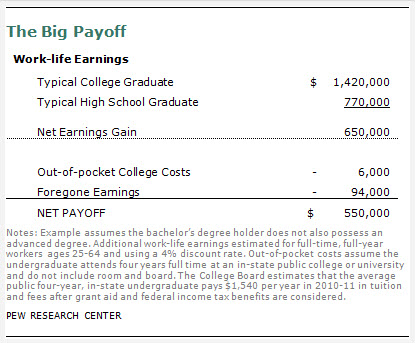
As a career coach and resume writer for nearly two decades, I can honestly state that I have never, even once, had a client who regretted getting an undergraduate degree… but I have had tons of clients regret just the opposite.

So, in summary, I strongly advise today’s youth to “Go For It!” Whether it is to create a career fall-back, to earn a credential that enhances credibility with strategic business partners, to open doors to the future, to serve as a role model to youth, or simply for self-esteem, a college degree, while certainly not an absolute requirement, is an achievement with a documented Return on Investment that you will definitely cherish for your entire career and life.

Why Looking for a New Job in 2011 is a Lot Like Fishing


O.K., so I’m not a member of any national angling societies, nor have I recently (or ever) entered any fishing tournaments, but I do know my way around a rod and reel, and I’ve caught everything from bass and trout, to flounder and cod. I’ve done fly fishing in Canada, lake fishing in New York, and both fresh and saltwater fishing in Louisiana’s bayous and the Gulf of Mexico.

But in my “reel” life (pun intended), I am a Certified Resume Writer and Career Coach. I have helped thousands of people find the jobs, promotions, and opportunities they want by preparing them, and in some cases, reinventing them for the challenges and changes in today’s job market. As I’ve gone about honing my craft, writing compelling resumes, and positioning my clients to get that great new gig (not another pun!), it has often occurred to me just how similar job hunting and fishing are.

As I see it, here are a few dead-on parallels:

1) In fishing, you’ve got to get up very early (I’ve never left for a fishing trip later than 5 a.m.) and be ready to brave the elements if you want to come home with a stringer… Most fish simply don’t bite late in the day…

In job hunting, you’ve got to contact people and network in the mornings… Nothing is worse than calling a potential contact and asking for a referral for a job opening late on a Friday afternoon.

2) In fishing, you’ve got to have the right tackle and the right bait or lures… end of story! If you get out on the water and suddenly notice that you’re missing the right tackle, it’s too late to go back and get it… Being prepared is the name of the game. If you’re not getting any bites and the folks in the boat right next to you are pulling them in on every cast, you need to find out what they’re using and that’s what you go with.

In job hunting, you must have the best resume, the best suit, and the best referrals / contacts (which you CAN find with our proven methods). Otherwise, you’re simply spinning your wheels (or your propeller!). In my resume and career coaching practice, I recommend what works, not what was done 15 years ago, or what somebody on a website claims.

3) In fishing, you take all reasonable preparations and precautions, and emphasize water safety above all else. Whether it’s ensuring that your outboard is properly maintained, getting your current fishing licenses, inspecting your boat for leaks, having communications gear and life vests in working order, or educating younger members of your party on the rules of the water, you must approach each fishing trip with professionalism.

In job hunting, you make sure your car or transportation to the interview is in tip top shape and allow time to change a tire or catch a cab if the need arises, you make a checklist of everything you need to conduct your job search (references, contacts, resume copies, cover letters, etc.), clean up your online image, if need be, improve and update your credentials and certifications, keeping in mind that your next job is the essential key to your future well-being.

4) In fishing, it’s often a good idea to use a guide. Now don’t get me wrong, most of the time I’ve fished, I went with buddies, family, or alone… but I have used guides and charters, and when I did, they were worth every penny. The fishing guide has the boat, has the best tackle, knows the hot spots, and even schools you on the best techniques (even though my buddies & I think we’re fishing experts).

Sure, I’ve read magazines like Field & Stream, Outdoor Life, or Louisiana Sportsman, and I often pick up helpful fishing hints and techniques… But let’s face it, with today’s busy life schedules, who can go fishing more than a few times a year? On the other hand, the guide goes daily or weekly, knows the ins & outs, knows the water, knows which baits are working, and takes my group right to the best spots. After all, if we catch a bunch of great fish, we’ll brag about it back at the office and he gets tons of referrals.

In job hunting, those who get professional help get the best results. You probably look for a new job every few years or so, you read a few magazine or online articles here and there, and maybe you even buy the hottest new book on Career Search. That’s simply not enough to keep up with the very latest in career search trends! There are new technologies that are landing great jobs (even in this troubled economy), as well as new leading edge changes in resume presentation techniques. In the Career Search industry, we obtain professional certifications, take continuing education courses, participate in ongoing webcasts, and attend annual conferences that are chock full of the latest in job search trending. When we “guide” you to your next great job, you tend to tell your family and friends, which is how we get our next clients.

So, the next time you’re fishing for a new job… angling for that upcoming promotion, or simply “testing the waters” (couldn’t resist), check out your Certified Resume Writer or Career Coach for advice… Most, like me, offer a free consultation.

Grant Cooper, C.A.R.W.
grant@resupro.com
1-800-700-9748

Home


Why “Irrelevant” Information is Absolutely Vital to Your Resume!

One of the strongest opinions that most people have about resumes, is that the information within them must be “relevant.” It turns out, however, that many jobseekers, and even resume writers, are leaving off items that could have propelled their resume creations to the top of the pile and resulted in a successful job search.

As an experienced, certified, and accomplished resume writer, a key function of my job is to conduct in-depth information-gathering sessions with jobseekers to gain insights into their careers that will be effective on their resumes. Time and time again, when inquiring into various specifics, I hear, “Oh, don’t put that in… it’s simply not relevant.” Or, “They don’t care about that.”

I’d like to give you a case history of a client who listened to my advice and landed a great fellowship because of it. I was creating a resume (actually a Curriculum Vitae) for a medical student who had completed his M.D. and residency, and was applying for a highly competitive fellowship in New York that offered only two slots nationwide, with many applicants. He phoned me shortly after receiving the first draft to say that his supervising professor suggested strongly that he take out the items I had placed in his resume describing his summer camp counseling positions during his undergraduate years. The professor said, “That’s irrelevant, they don’t want to see that. Only put in your academic and clinical information.”

Based on my advice, however, my client decided to keep the items about his summer camp counseling in the resume, and called me 6 weeks later to thank me. “Grant, the Director who interviewed me not only told me that he chose my C.V. because of the years of summer counseling, but he spent 10 minutes of the interview talking about it!” he stated in a triumphant tone.

It turns out the Department Director who interviewed (and later selected) him had two young children in a summer camp, and was anxious to learn more about how counselors interact with the children. Incidentally, the fellowship he landed was in Oncology, not Pediatrics. He also expressed that he preferred fellowship candidates that not only demonstrated excellent academic and clinical accomplishments, but also had a background showing great “people skills.”

Although this is only one anecdote from thousands I have witnessed in my nearly 17 years in the career development business, I have become convinced that it is often the “irrelevant” bit of information in a resume that catches the eye of the reader.

Grant Cooper is a Certified Advanced Resume Writer, author of numerous career-related articles published in journals, newspapers and online, and is the founder and president of Strategic Resumes, professional resume writers providing the best in resume writing services. For more information visit www.strategicresumes.com.

Six Questions to Ask Before Hiring a Resume Writer

Question #1 – How many years of experience do you have as a full-time resume writer?

While tons of experience by no means guarantees that a resume writer has the “write stuff,” significant lack of experience (two years or less) generally indicates a lack of breadth in the types of knowledge that you would want to see in someone summarizing your career into a polished document. A less experienced writer who works closely with a more experienced mentor, however, should be just fine.

Question #2 – Are you a Certified Resume Writer?

There are at least four major organizations that certify resume writers. If a resume writer claims to be certified, you can confirm their status by visiting the websites of those credentialing organizations. The four main organizations are:
• Career Directors International (CDI)
• Career Masters Institute (CMI)
• Professional Association of Resume Writers & Career Coaches (PARW/CC)
• National Resume Writers’ Association (NRWA)
A resume certification means several things, all of which should be important to you as a potential client. First, it means the writer took the time, energy, and resources necessary to join a professional organization. That is, they see themselves as professionals and are serious about their craft. Second, they have passed an examination, submitted samples of their work, and passed the scrutiny of their peers. Many attend annual conferences where they are updated on the latest and most effective techniques in resume writing (ask your writer if he/she has attended a conference recently).

Are all Certified Resume Writers going to be excellent? No, just as all accountants or doctors are not at the top of their profession. But your search should definitely begin with verifying certification. Also, most credentialing organizations have a “mediation” process in the event you have a serious dispute with your writer.

Question #3 – Do you have experience in writing resumes for my field?

Since you are obviously an expert in your own profession, it should be fairly easy to engage the writer in a conversation that will reveal his or her knowledge. Unless your field is completely unusual, any good resume writer should be able to “talk the talk” and know much of the lingo of your profession. For example, if you are a medical office manager, the writer should be telling you they have experience in writing for clients who understand HIPAA compliance, ICD-9 and CPT codes, and Medicare / private insurance billing procedures. Writers are most effective when they have experience in the specific field involved in the resume.

Question #4 – How much will my resume cost?

First, you should distinguish between resume “typists,” who simply type and format the wording that you provide… and resume “writers,” who gather information from you and other sources, creating a unique, compelling resume that is likely to generate interest by decision-makers. Also, there are “resume mills” on the Internet that charge very low prices (kind of like getting your car painted “like new” for $99). A reputable firm with experienced, certified writers will generally charge anywhere from $300-$750 per resume, depending upon your career level and other factors. If the price is significantly below or above this range, alarm bells should go off.

Question #5 – Do you have a guarantee? If so, what is it?

Most resume writing organizations I have checked out offer, at the very minimum, a “rewrite” guarantee. That means that if you are dissatisfied with the first draft, they will take input from you on your concerns, and generate at least one rewrite. Some writers “guarantee” that your new resume will generate interviews, but again, their remedy is to rewrite your resume. If you can find one of the few resume firms that offer an unconditional money back guarantee in case of dissatisfaction, that is the best you can do. Some writers will maintain that they are so good or so professional, that no guarantee is necessary. If that is the case, you should make your own decision on how to proceed.

Question #6 – When will my order be completed?

Unless your background is extremely complex (I’m thinking of an internationally renowned scientific consultant who has made presentations on three continents and published 20 scientific papers, etc.), your resume should be ready in a week or less, preferably a few days, unless you do not need it quickly. Any longer than a week is generally not a good sign. I have seen resume writers who are great at taking in orders, only to let them gather dust and finally “crank them out” when pressed by the client. Of course, the timeline for completion only begins once you have furnished all of the information requested.

Grant Cooper is a Certified Advanced Resume Writer, author of numerous career-related articles published in journals, newspapers and online, and is the founder and president of Strategic Resumes, certified resume writers New Orleans. For more information visit http://www.strategicresumes.com.

Hello world!

In the coming weeks, months & years to come, I will be blogging a wide range of insider tips, career search ideas, a few secrets, and as they arise, direct suggestions for jobseekers and entrepreneurs. I will endeavor to make myself available through email, LinkedIn, Facebook, and other media to answer questions and provide any help I can. I’m looking forward to finding out the challenges you face, giving you fresh new ideas or resources, and hopefully giving back some of the help others have given me!

Making You Look Great!